State of the Union: Mozilla Badges

Our work within Mozilla—co-creating great open source software, working with longstanding contributors, interacting with our larger volunteer community—ties in perfectly with badges. Recognizing people for being great at their jobs, acknowledging active collaborators, encouraging folks to deepen their participation is a no-brainer for a community-built and community-reliant organization like ours. Consequently, we’ve begun to develop and pilot internal badge systems within different areas of the organization. Not surprisingly, this growing group of Mozilla badge systems is revealing itself as fertile ground for investigating the development of a variety of badge systems.

Because we work in the open, because many people might find our badging work to be useful as background research into their own work, because we’re large enough that not everyone here is yet aware of the badge design work that’s happening at Mozilla, and because a number of folks have been inquiring about where they might earn badges, I’ve gathered all the badge work that is currently underway or planned for 2013 into this single blog post.

Some Mozilla badge systems pertain directly to education and learning, some are more heavily  focused on capturing and acknowledging prior work, while others are based on encouraging greater commitment to the community. Different badges for different requirements and all of it happening under the Mozilla tent. Nice.

The list of Mozilla badges for 2013 (in very loose chronological order):

  • Webmaker badges
  • Web literacy standard badges
  • WebDev badges
  • Capture Mozilla badges
  • Webmaker Mentor badges
  • SUMO badges
  • Engagement badges
  • QA badges
  • MDN badges
  • Student reps badges
  • Creative badges
  • Affinity badges
  • Air Mozilla badges

Webmaker Badges
Many of you are familiar with the Webmaker badges that we debuted at MozFest last year. Those included mini-skill badges earned for learning basic aspects of html and css, along with badges for activities and participation at MozFest 2012. Good news! We have more planned for the coming year. In fact, I’ve just written a great shareable tweet for webmaker badges and I’ll share it here because, this summer it’s going to come true. “Coming soon: Mozilla #webmaker badges built on the community-driven Mozilla #weblitstd; assessed and awarded by peers to peers.”

No doubt by now you’re curious. “What are the peer assessed badges that I will be able to earn this summer?” Good question. Here’s what will be available: badges for remixing, HTML, CSS, composing for the web and credibility. But how did we arrive at these? There’s something more at work here, and that brings us to our next badge system.

Web Literacy Standard Badges
If you haven’t been following our work with Web Literacy, there’s still time to get in on the action. We’re working with the Mozilla community to develop a web literacy learning standard. A standard to which organisations may choose to voluntarily align. We’ve made great headway and we’ve just announced our first Web Literacy Standard draft! For those of you who need a TL;DR of this work, here’s another tweet length explanation, “Co-creating a web literacy standard w/ the Mozilla community. Addressing assessments & badges. Join us:
http://mzl.la/106TtlP
#weblitstd” Feel free to share that statement on your twitterstream.

Over the last month or so we’ve worked through a mountain of content to a series of areas that we’re calling strands for now. There are three primary strands: Exploring, Building and Connecting that are composed of competencies like remixing, HTML, CSS, sharing, credibility, collaboration, security and privacy. These competencies will be used as a foundation for web literacy badges. Web literacy badges that you’ll be able to earn accomplishing projects here at Mozilla, but that you’ll also be able to earn for work done elsewhere on the web. With the development of these badges we will accomplish our goal of developing a distributed learning environment as well as a distributed badging network, stewarded by an organization dedicated to keeping the web open and free. That’s hard to beat.

I’ll certainly have more to share about web literacy badges again in the future. Indeed, here are two “-quel” badge pathways posts to further explain where we’re headed with the web literacy badge work.

WebDev Stewards Badges
We were really excited to hear that the Web Development stewards were interested in issuing badges recognizing the meaningful contributions that volunteers have been making to Mozilla over the years. They had already put together some basic criteria and done some preliminary thinking about what their badges should represent and how they should be awarded. With that much work already considered, the team felt emboldened to try something new with this endeavor: working with the community to develop the designs for these badges. Considering that these badge represent community participation, it made a sort of beautiful sense to us that they be designed by community members. And so they were.

We received a number of really wonderful designs, some of which made us think hard about what we were communicating through the visual designs and some of which just made us say, “ahhhhh.” There’s much more to say about badge visual design and we’ll cover that in a future post, but I’ll note here that these designs correlate quite nicely with the subject matter that they’re meant to represent. Friends, this is no small feat. Kudos to the team on that. I wrote a bit about these before and I’ll revisit the process of getting to the final product in another post, but for now I’ll just let these badges speak for themselves. (To learn a bit more about our design process, read this fine post by John Slater.)
Screen-Shot-2013-03-08-at-1.03.43-PM

Capture Mozilla Badges
I learned of the Capture Mozilla badges through a surprise posting on Yammer. Learning about these badges was like earning a stealth badge—surprising and delightful. Mozilla team members finding ways to acknowledge their contributors in ways that are public and shareable through Open Badges. Yes! Of course, we were excited to hear about it and we reached out to Dia Bondi, who along with Sean Bolton and Dino Anderson, is endeavoring to encourage people to contribute to the Mozilla repository through recording their experiences on video, even in less than perfect ways. Knowledge permanently captured is knowledge that continues to work.

Attempting to counter the inaccurate notion that on-camera skill is required or that a lot of preparation is involved, Capture Mozilla turned to badges as a way to be able to “talk about [the] project in a way that acknowledges other people’s contributions.” The team is thinking about the next steps for Capture Mozilla badges, in particular deepen the badging structure. Dia notes that “badging will allow the project to scale.” Music to our ears. People, earn those badges!
af4cc219466a14139af53844678f4187_image_1365531174_0374

Webmaker Mentor Badges
The Webmaker Mentors group is tearing it up with their work on the Webmaker MOOC, ”Teach the Web” that is taking place May through June. The team is testing out a number of theories with this work. And they’re integrating badges into their approach. They’ll be offering a series of four Mentor badges. These badges are nicely reflexive in that they reinforce the very thing they seek to recognize, because when you earn the Mentor badge, you in turn become able to review other people’s work for mentor badges. All in all, a great system that encourages community participation while also acknowledging learning and growth. By the way, these badges will also help folks ramp up for Maker Party 2013: Learn, Remix, Sharecoming to you this summer (or winter, depending on which hemisphere you call home).

SUMO Badges
SUMO badges are in the planning stages. Roland Tanglao is busy working his way through some foundational aspects of this badge system. For those of you who are curious as to how this comes together, you might be interested in taking a look at the fun google spreadsheet I’ve devised to helps folks (and myself) think through content.

Engagement Badges
With the recent Firefox OS work, it sort of makes sense that we’d want to start acknowledging peoples’ participation through badges. Emily Goligoski has been working with Chelsea as Engagement start thinking through their four proposed badges aimed at Mozillians and Mobilizers who have participated in Firefox OS launch activities: Firefox OS Events, Firefox OS Trainer, Firefox OS Launch Day and Firefox OS Core Team. It’s still early days and these may change, but suffice it to say that they’re on their way to acknowledging their contributors in a new and dynamic way.

QA, MDN, Student Reps, Creative, Affinity, Air Mozilla
We’re very much looking forward to working with these groups to implement badges. Certainly, QA, Mozilla Developer Network (MDN), and Creative are essential components of what constitutes Mozilla to the outside world. Student Reps provide some of the major firepower behind our offering.  Affinity is weighing the options about ways to acknowledge types of commitment, both financial and temporal. They’re also working hard to ensure that their badges have rigor and value associated with them. Air Mozilla is the newest kid on the badges block. This bunch represents a wide variety of potential badges emanating from Mozilla. We can’t wait to work with them to bring them to life.

Thank you!
That’s a quick summary of the groups within Mozilla who are interested in developing badges or are already in progress with them. If I’ve missed mentioning you, or if you’re interested in working on badges in your area, please contact any member of the open badges team: we’re all happy to work with you. We are deeply grateful to the Mozilla folks who have already reached out to the Open Badges team seeking new and innovative ways to enhance their communities, recognize commitments and acknowledge participation. To say that we’re excited about next steps is to significantly understate our enthusiasm. Just a quick heads up on some immediate next steps, shortly we’ll be meeting with Annie Elliott to begin thinking through metrics for Mozilla badges: another exciting avenue to explore.

And finally, a quick and specific note of thanks to David Boswell for his fantastic work with the Community Builders and Grow Mozilla teams; he and they are proving to be invaluable partners in the ongoing development of badges here at Mozilla.

More soon.

Badge pathways: part 2, the “quel”

badgetypes1badgetypes2badgetypes3


In the badge pathways paraquel post we discussed the importance of the whole system and how your badges can coalesce into something greater than its parts. But let’s talk about what the parts of the system are. The parts of the system can include badges, goals, earners, organizations, stakeholders, and time. Why is it important to discuss these when we’re talking about badge pathways? Because your badge pathways will come about through pushes and pulls in the system; through different desires and needs manifesting themselves through the medium of badges.

Chains of importance, cowpaths & desire paths
In a recent conversation on the Webmaker google group, Christian Briggs shared some of his thinking about badge pathways. He mentioned a process of discovery he and a team had worked out that addressed chains of importance for all folks. This aligns with much of our earlier thinking and writing here.

At a meeting about the future of badges earlier this year, I floated the idea of badge pathways as essentially cowpaths. I mentioned this in reference to the idea of “paving the cowpaths”; seeing where the traffic goes and then paving where the paths are worn. As you can imagine, if you’re not familiar with this phrase and its related concept, it can take some getting used to. Rafi Santo kindly jumped in to offer the much more preferable desire paths. But regardless of the language used, what’s valuable and important here is where someone wants to go versus where they’re told to go.

Descriptive pathways vs. prescriptive pathways
Let’s take a minute to understand the difference between descriptive approaches and prescriptive approaches. Descriptive pathways approaches seek to acknowledge the ways that people willfully choose to earn badges. This technique may feel more natural to the badge earner since they’re defining their own paths. In this manner, the badge earner makes use of personal agency. Prescriptive approaches seek to declare one standard or recommended badge earning path over another. It can feel more limiting and formal. The badge earner is compelled to follow the proposed pathway or drop out of the pathway. Each approach has its own pluses and minuses.

The three-fold path
Several potential uses of these two approaches exist. For example, people may choose to (or be compelled to) move through a badge system in these three ways:

  1. Command path: suggested or recommended badge arcs.
  2. Contract path: desired or pledged badge groupings.
  3. Badge desire path: independently followed or pursued badge passages.

The importance of the distinctions between these paths cannot be overemphasized. Why? Because to the earner, each of these avenues will feel very different.

badgeflows

Part of the beauty of open badges in general is their extreme flexibility. This flexibility extends all the way from their creation to their earning, from their earning to their consumption. The system is designed to accommodate flexibility and alternative uses. This means that all badge creators/issuers are developing badge systems that will express emergence—one way or another. And one of the ways that emergence will come about is in the ways that people will choose to progress through your badges. So let’s return to the three different pathways.

Command pathways
The command approach is the most prescriptive: it relies on a formal, structured and recommended path. Most likely, this badge pathway will be linear—a straight line from one learning experience to another. This is not unlike what occurs in many school courses.

Contract pathways
The contract path encourages the earner to think about and select a potential learning arc. In the strictest sense, it, too, is prescriptive. But because its prescriptiveness is set forth by the earner herself, the potentially dictatorial nature does not carry the same paternalistic qualities.

Desire pathways
The badge desire path carries with it the greatest capacity for knowledge and system emergence. When there is no prescribed pathway, people can find the way that makes sense to them; can choose to follow other people’s paths or can strike out in very different directions.

The learning trail
All badge earners leave behind a trail. That badge trail may prove to represent merely a series of required steps; that path may illustrate a series of revealing, personally inspired choices, or that path may appear to be erratic and nonsensical, indicating nothing. But rarely is that last example the case. All of these directions may make perfect sense to the badge earner. But perhaps the one that makes the most sense to her is her own constructed narrative: the path that she develops a story about, even if her story can only be understood in retrospect. Sense-making often occurs after an experience: that doesn’t render the process any less meaningful, even if that process has seemed peculiarly arbitrary and idiosyncratic. They’re sending you messages about finding meaning and building personal value in the midst of communication chaos. And do not underestimate the immense power of self-reflection and self-assessment. Indeed, the badge earning iconoclast asks the badge system—and the people designing it—to not only acknowledge their atypical badge pathway approaches but also to appreciate their unique ability to see what might be rather than what is. They’re your badge system’s true north.

- – -

More soon.
carla [at] mozillafoundation [dot] org

Badge system design: investigating assumptions

Last week during the Open Badges community call, we introduced a new repeating discussion area: badge system design. (We’re considering expanding badge system design into a standing call of its own and so we’re testing the depth of interest within the existing community call.) The first few questions I posed to our call tribe were, “What assumptions are there about badges? What have you been running into in your discussions? Where do your assumptions lie?”

Karen Jeffreys of ForAllSystems was kind enough to share her thoughts with the group and this, in turn, acted as a catalyst for additional thoughts within the group. After her initial verbal response, during which I took notes, a number of others began a flurry of writing in the etherpad. Folks also began to verbally pour out their thoughts on this subject. Success! We had hit upon a previously untapped area that was worthy of exploration and conversation. It seems that there are a number of assumptions that everyone is working with as they progress through the discussion, creation and sharing of badges.

While the group wrote and spoke about a number of different areas—and we ran out of time on the call—their responses tended to fall into these categories.

  • Languages/terminology/semantics assumptions
  • Usage/sharing assumptions
  • Perceptions of badge types
  • Process assumptions
  • Technical assumptions
  • Educational assumptions
  • Risk/assessment assumptions

Languages/terminology/semantics assumptions
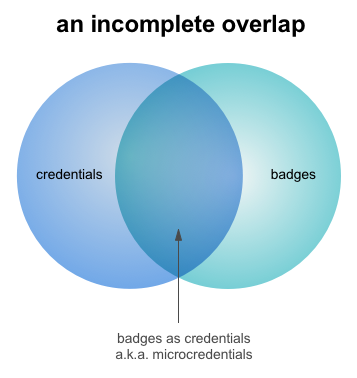
Let’s expand upon these assumptions a bit further, starting with the first bullet point. The languages/terminology/semantics area is fairly large and covers a variety of assumptions. In particular, our community members noted varying interpretations of the word “badge,” the use of metaphors or other descriptors for that word, such as “micro-credentials.” This is definitely an area we have heard before and one that we will continue to investigate.

Usage/sharing assumptions
The occurrence of usage assumptions appears to be on the rise as more people become aware of badges. This may be due in part to folks assuming that all badges represent learning, when badges can be used to indicate affiliation, as well as achievements that are not related directly to “learning.” Badge usage represents an area for further study as it relates to the life cycle of a badge: issuing, earning, sharing, consuming. With regards to the sharing assumption, we have been assuming that once badges are earned that there would be a ready marketplace for them, not only from a personal representation perspective, but also from a community appreciation of them. But there may also be reasons why people choose not to share their badges: deeper investigation into different demographical behavior patterns for sharing / not sharing is warranted.

Perceptions of badge types
Perceptions of badge types is linked to usage assumptions as well as audience assumptions. Since by their nature badges are so protean, they can be used to represent a huge variety of different concepts, things, ideas. Mozilla has been building badge systems based on three types of badges: participation, skill, and achievement, but there are many other ways to slice the badge type pie. Contextual understanding of the conceptual framework of a badge system is necessary to fully comprehend not only its goals but its success at achieving those goals.

Process assumptions
The process assumptions seem to stem from different interpretations of how a badge might be used—and how a badge system might be implemented. There are many types of badge systems, therefore they can be interpreted in a variety of ways. As we share our badge work with the world, it’s important to realize that how we think that our badges will be used or perceived may not match up with the ways that they are perceived. Issuers may have assumptions about how they fit into their process and yet, hiring organizations may have an entirely different set of assumptions about how best to use badges. To that end, research and reflexivity should be built into the process.

Technical assumptions
From Mozilla’s technical perspective, open badges can be relatively easy to implement. However, from an outsider’s perspective, or a non-technical perspective, they can seem like a wonderful solution that can only be viewed behind a glass window. Differing levels of technical expertise can make the creation of an open badge system seem complex. There are differing perceptions of the technical chops necessary to implement badges effectively. While badge creation and issuing platforms are easing the process every day, there are new concerns being raised about vetting, consumption methodologies, and open source requirements surfacing. We must remain vigilant about assumptions about technical implementation and ease of use.

Educational assumptions + Risk/assessment assumptions
Badges have been received into the educational world with open arms. Consequently, a variety of assumptions about usage within that environment and possible best practices have arisen, too. Assumptions are rampant about varying pedagogies, the dilution of educational efforts, the devaluation of formal credentials and the meaning and value of different types of assessment. Education is a cultural touchstone and masses of perceptions exist about how and what are the best ways to teach or to learn. What does it mean to introduce another form of assessment within the educational world? How will it be used and by whom? Badges help to expose many of our pre-existing tacit assumptions in this realm. Accordingly, it’s vital that we work to unpack the thinking associated with badge use within this existing, extremely complex system.

Conclusion
Badges open many doors to many solutions, but those doorways need to be investigated and understood as having their own meanings as well. The only conclusion to be reached here other than understanding that badges are dynamic, vital things that can be interpreted in many very different ways, is that it is useful to understand the contexts in which we are creating, sharing, disseminating and conversing about badges.

Thanks to the community for sharing their thoughts on assumptions. I invite you to share yours as well. More soon.

Badge System Design Principles, Part 1: RFC

Flickr image courtesy of  justus.thane

Flickr image courtesy of justus.thane

Badge system design paper released
A quick post to direct you to a new paper that I’ve been writing about badge system design principles: Badge System Design Principles, Part 1. It’s a publicly accessible document open for comments. But, a bit of context first: I felt that it was important to develop a paper that focused specifically on principles of badge system design. Once we have established the basic foundational principles—and there are ten to start with—we can focus on best practices and recommendations in later documents.

Comments welcome
Please do us the honor of reading and commenting on this paper. While comments will remain open on the document for this week and the next, I’ll be using all comments gathered by April 19th to begin revising the paper. Also, the next paper in the series, Badge System Design Principles , Part 2, will be released for public comment right around that same time, April 22nd.

Ten principles: five now, five later
This paper addresses ten principles and focuses intently on the first five while lightly skimming the remaining five. This provides enough room to focus on important areas without giving short shrift to content that deserves deep and meaningful discussion. And while the first five are covered in some detail, much more could be said and written about them, in particular the goal definition. I’ll be dedicating some blog posts to those areas to flesh them out even further.

The ten principles of badge system design include:

  • team selection*
  • goal definition*
  • environment definition*
  • audience definition*
  • badge types*
  • languages (including verbal and visual)
  • timing
  • technology
  • assessment
  • pedagogies / alignments

* covered in detail in Badge System Design Principles, Part 1.

I appreciate all feedback received thus far and look forward to seeing even more. Thanks for working alongside us in developing and sharing this work. If you’re in the midst of developing a badge system, let’s talk (contact info below). I’ll be setting up office hours soon and will post them here when they’re underway. Thanks!

Much more soon.
carla [at] mozillafoundation [dot] org

Badge pathways: part 1, the paraquel

badgepathwaysA few weeks ago I posted this image and stated that I would be following up with several posts about badge pathways. In particular, how they fit into our work at Mozilla along several different lines: the web literacy standard, webmaker, and open badges. Straightforward, yes?

Badge system design, white papers & badge pathways
Sort of. This is the paraquel (!) post coming before the quel itself. I have an inkling that there’s a prequel yet to be created because quite some time ago I started a post about how these tasks all come together from a conjunctive / disjunctive approach. In fact, all sorts of -quels are in the offing, the main event being a white paper about Badge System Design. While I have written quite a few blog posts about badge system design before, a solid white paper along with some example cases will help to more fully explain our direction of thought travel.

So, let’s take a minute to talk about what step comes both after badge system design and very much in the middle of it: badge pathways. Like many complex, long-form thoughts, it’s hard to say exactly when this idea began to ease itself into the (badge system design) picture.

The threequel
But first, a look down the road to where the next few posts will be heading. This first post will address how we got to thinking about badge pathways from a badge system design perspective. The following second post will address how we’re working with them and where they might be effective. And the third and final post will consider how badge pathways might link together vast systems to more accurately represent the individual learner and how that might be represented.

Finding networks
About two weeks ago at Dan Hickey’s digital badges design principles workshop, just prior to the DML conference in Chicago, I had the opportunity to speak to many of the impressive DML winners. Dan’s work along with his grad students’ work digs into some really interesting areas arising from grantees’ experiences. The DML grantees have created some amazing badges and badge systems and hearing them describe their work as the day progressed was particularly enjoyable, especially when they discovered unanticipated commonalities with each other.

During that gathering, Dan asked me to speak to the assembled group about the importance of badge system visualization, an absolutely sound and worthy discussion point. I started off with the best of intentions about responding to his extremely rational request but soon enough found myself diving into a soliloquy about badge pathways. It was a heady few moments. One in which I may have even asserted something along these lines, “Badge pathways are more important than badges themselves.”

What?! To the attending audience this statement may have seemed completely strange and unexpected. Yet with a bit of pruning, that statement is true. Badge pathways are just as important as badges themselves. And, with a bit of hindsight, I now realize that a visualization like the one above begins to illustrate exactly how relevant that comment was, so I was answering the question Dan asked, but I was speaking about it in a new way.

What’s a badge pathway?
A quick sidebar to clarify what we mean by badge pathways. Let’s start with what they’re not. Badge pathways are not necessarily predefined, nor are they limited to one educational category or issuing organization or type of learning, nor do they necessarily have an end point.

And now let’s address what they are. Badge pathways can be and most likely will be entirely emergent. This, friends, is from whence all their magic derives. Badge pathways provide people with opportunities to make decisions based in personal agency, to define steps that may seem more like hops, and to think about ways to do things that aren’t sequential or even seemingly rational. They allow earners to link unexpected badges (read concepts, learning, achievements, etc.) together in exciting and unanticipated ways. They allow folks to connect the outlying dots that constitute lifelong learning. And while predefined badge pathways can provide easy and simple directions and pointers along a certain direction, the self-defined or peer-defined or team-defined pathway can resonate in ways that may prove far more meaningful to an individual than those that are suggested by experts. Badge pathways can act as a form of distributed intelligence. In that way, badge pathways are inextricably linked to badge system design.

Order from chaos
What we have repeatedly spoken about—that your badge system design must be flexible, that there are multiple ways to learn things, that badges are outcomes of learning—is still all true. But as you work through your badge system, as it evolves past the first 10 or so badges, you’ll find that prescriptive and descriptive approaches begin to come seriously into play. In other words, the angle with which your badge system is viewed can easily shift from a prescribed series of steps to a free for all wherein earners pick and choose their own way and the pathways you think you’ve created are not the paths that people are following. Here’s an opportunity to embrace the chaos of your system. Chaos that given enough time will reveal order. Order that will have evolved from actual usage.

The most stunning thing living systems and social systems can do is to change themselves utterly by creating whole new structures and behaviors.… The ability to self-organize is the strongest form of resilience. … Self-organization is basically the combination of an evolutionary raw material—a highly variable stock of information from which to select possible patterns—and a means for experimentations, for selcting and testing new patterns. … The source of variety is human creativity… (Meadows, 1999, pp 14-15)

A recommendation
When you are deep into designing your badge system, pause. Look outward: consider the bigger picture that your earner will see. Imagine the thrill of being a learning explorer charting new territory with badges as your guideposts! Now with that new perspective, rough out some potential badge pathways that do not solely include your badges—that include far flung and seemingly unrelated badges. Begin to imagine a future where your badges mingle with and build on a variety of other badges; where new constellations of learning pathways evolve into being from earners devising their own paths, guided by light from distant badge galaxies.

More soon.

references:
Meadows, D. (1999). Leverage points: places to intervene in a system. World91(7), 21. POINT. Retrieved from http://www.sustainer.org/pubs/Leverage_Points.pdf 

Share this:

Open Badges launch + Web literacy badges underway

Mozilla Open Badges: the launch approaches
Good news, everyone! Mozilla is preparing to launch Open Badges 1.0 at the DML Conference in Chicago next week. We’ve been operating in public beta since April of 2012. During the intervening time our team has spoken at numerous conferences, written a badge validation paper, and grown to include additional brilliant team members who are sprinting to bring it to the first finish line. Because a system is an evolutionary process, we don’t really consider this the finish per se, but instead think of this as a time to herald the initial public launch of 1.0.

4703930702_3b5e77b785_z

This is a moment worth celebrating. Mozilla is launching not just a product but an entire ecosystem. Not only will Open Badges enter the world as a product, we will also begin to see the ecosystem populate more fully. There will be at least thirty new organizations beginning to issue Open Badges and Mozilla is proud to be one of them. Not only are we working on web literacy badges but we’re thrilled to announce Mozilla WebDev badges. These soon-to-be-earnable badges were designed by a member of the Mozilla community. Seeing the community begin to actively participate in the creation of these badges is deeply rewarding. And here it’s worth pausing for a moment to distinguish the important differences between digital badges and Open Badges.

Digital badges vs. Open badges
Digital badges are electronic versions of badges; they can have some metadata associated with them but most do not. An open badge is a specific type of digital badge. The open it refers to is partly technical (it works thanks to open source software), partly ideological (it’s based on an ethos of openness). By issuing open badges rather than simply digital badges, organizations are aligning to a standard that they have helped to create.

What the open in open badges means
Open badges are embedded with content. They make use of a standard set of metadata that allows them to act in ways that not every digital badge can. One of their hallmarks is badge interoperability. In practice, this means that when someone wants to know more about an open badge, they merely have to click on it. It’s worth noting that an open badge does not indicate that it is a Mozilla-specific badge but that it hews to a community-defined and agreed-upon set of metadata standards. An open badge will always communicate:

  1. the issuer: the organization, institution or individual issued the badge,
  2. the earner: the person who earned the badge,
  3. the criteria: information about what was required to earn the badge,
  4. the evidence (optional): it may also include earner-specific associated evidence and
  5. the expiration date (optional): they can be set to expire at a given date.
  6. It may also include the standard(s) with which the badge aligns, e.g., common core, Mozilla web literacy standard*

* Issuers interested in good badge design and badge system design, though, make use of the opportunity presented by this new ecosystem by setting their own standards. It’s more than likely your standards/criteria are superior to other existing standards. Suggestion: Define your own and let other organizations meet them.

Web literacy badges
Speaking of defining your own standards, that’s just what we’re in the process of doing: developing a Mozilla Web Literacy Standard. Read that as the “royal we” because it’s Mozilla plus a variety of folks interested in co-creating it with us. We’re also in the midst of defining a web literacy badge system framework. It will be flexible enough to include Mozilla issued badges but also recognize and accommodate non-Mozilla badges. While affiliating with the new #weblitstd will be entirely optional, if you choose to do so you can then choose to implement any of the following representational manifestations:

  1. earn Mozilla web literacy badges
  2. issue your organization’s own web literacy badges
  3. work with us to develop equivalency correspondences between badge systems.

We’re still fairly early on in the process of one and three. (Check out our in-progress roadmap.) The third point above presents some extremely exciting opportunities for the development of a strong and robust badge universe. That universe will include webmaker badges but will expand with the Web Literacy framework to include badges that are earnable through other tools, not just Mozilla webmaker. I will more fully address the conceptual framework in upcoming badge pathways posts that will appear on this blog over the next few weeks.

Flickr image courtesy of NASA APPEL

Congratulations to the Open Badges team on this impressive accomplishment and good luck to the Web Literacy standard and badges team. It’s an exciting time to be working on badges. Much more soon.

Boundless learning: the continuum of web literacy

There are a lot of people who think that our educational system is broken. I tend to think of it as problematic rather than broken—because it still works for some people, just not everyone. Wouldn’t it be great to have a system that works for more people in new ways?

A look back to look forward 
Here’s how we may have arrived in this confusing spot regarding education, a spot that is overripe for reimagining. The web.

The web is limitless. And its limitlessness has revealed to us the profound limits bound into earlier systems of knowledge measurement. Let’s use an example. Books were a previous primary yardstick. And we thought that all of them gathered together in the form of libraries constituted a window onto the edge of knowledge.

The lure of the past
But with the rise of the web in the last few years, we’ve realized that that was a false limitation. Libraries, even spectacularly large ones, that previously seemed like they contained all the information in the world are competing against an ever-growing, easily accessible accumulation of knowledge from around the world. The last Encyclopedia Brittanica—for years considered the gold standard for reference to be found in a printed set of thirty-two bound volumes at the cost of $1395—is now dwarfed by a free site on the web. That free site? Wikipedia. Over four million articles can be found on Wikipedia; it contains over twenty-nine million pages. That’s just one site on the web. And interestingly enough, it’s a site to which many editors contribute but that no one person “owns.”

2453225976_81ef3a4aa1_z

“The web has allowed us to see that the world is significantly more complex and interesting than we thought it was.” (2012, Weinberger) Indeed, the web mirrors much of our world in that it:

  1. contains massive amounts of information,
  2. has a distributed ownership model, and
  3. a large part of the information found on it is entirely free.

A new model for learning
Thanks to a lot of people who recognized the value of the web (and who like teaching and tinkering and sharing) learning can now happen and is now happening anywhere and everywhere. So, how can we break free from the limited thinking that chains us to book learning and formal academic levels? Can there be alternative methods of information dissemination?

The learning continuum
Let’s agree on this: learning is a process. There is no endpoint.  But what does this mean for education? That there is no cap to the amount of knowledge we can accumulate. And now because there is no endpoint, we need to rethink how people might find their way through this glut of information. We need something to fill in the space of what was there previously—or at the very least to find a way to acknowledge the new learning spaces that we’re beginning to see.

The last printed Encyclopedia Brittanica was published in 2010. It’s now 2013. The world has not stopped amassing information in that interim. So, we must become comfortable with the idea that there are volumes of knowledge that we’ll never know. It’s simply not possible to do that anymore; it’s not possible to put edges or boundaries on learning opportunities. This is where badges can provide their greatest value: as guideposts in an increasingly complex knowledge universe. Badges can be issued on an atomic level. We can start to acknowledge the primary elements  that constitute a basic level of knowledge.

I’m hesitant to even use the word level here. Due to its requirement for contextual definition, the idea of educational levels often leads straight to a bizarro world where levels are spoken about as if they’re universal, but their implementation reveals that they are most distinctly not universal in application.

Let’s just say that there are continua of knowledge and as a whole we are on them. To quote my colleague, Doug Belshaw, from our in-progress web literacies* white paper, “Literacy is a condition to be obtained not a threshold to cross.” The key to that statement centers on the idea of conditions: we are continually moving through and across boundaries of knowledge. This is one of the beauties of the web—and of life. In general, the boundaries we experience have been created and defined by us in the development of our society. Badges let us reimagine what those boundaries are and where they might appear. Thus, we can move ever closer to aligning our ability to acknowledge all of the learning now possible with the web’s vast capacity for increased knowledge acquisition.

Learning pathways 
Right now we’re focusing on what a web literacy standard might look like and how it might be implemented. A significant portion of this thinking will include developing potential learning pathways. Along those lines, we will be thinking through the framework’s ‘Beginner’ and ‘Intermediate’ levels before considering ‘Pre-Beginner’ and ‘Advanced’. Taking this approach will allow us to produce multiple touchpoints and signposts along the way to web literacy. We’ll use those touchpoints and signposts to develop a web literacy badge system that accommodates various learning pathways, builds upon the web literacy framework, encourages continued community badge creation and aligns with Mozilla’s Open Badges Infrastructure.

The honor of your presence is requested
There are many ways that you can participate. Here are just a few:

  1. Join our weekly web literacy standard community call on Thursdays 8am PST / 11am EST / 4pm GMT. Here’s a canonical etherpad agenda that includes dial in information.
  2. Visit our continually updated wiki.
  3. Continue to read and respond to these posts.
  4. Share your ideas about what might be useful indications of learning.
  5. Begin to imagine a world where web literacy is an easily understood literacy with badges that communicate where someone might be on that arc.

We’re gathering together with you at the forefront of our understanding of what web literacy is and we’re aiming to map out a workable future. We’re pretty excited and we’re really glad you’re here.

* It’s worth noting that we’re distinguishing between our earlier work with web literacies and our new efforts for a web literacy learning standard.

Flickr image CC by mikeedesign

Much more soon.
carla [at] mozillafoundation [dot] org